
Posted by Tanuj Rastogi on 6th Aug 2026
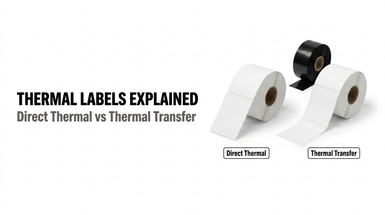
Thermal Labels Explained: Direct Thermal vs. Thermal Transfer (Which Do You Need?)
A thermal label is a label printed without ink, toner, or ribbon — the printer uses heat to create the image directly on (or through) the label material. That's what makes thermal printing faster, cheaper to run, and popular for shipping, retail, and warehouse labelling. But "thermal label" actually covers two quite different products, and picking the wrong one is the #1 reason people end up with labels that fade, smear, or don't survive the trip to a customer's door.
There are two types of thermal labels:
- Direct thermal labels — heat-sensitive paper that darkens directly under the printhead. No ribbon, no ink.
- Thermal transfer labels — a synthetic or paper label printed using heat to melt ink from a ribbon onto the label surface.
Direct Thermal vs. Thermal Transfer: The Real Difference
| Direct Thermal | Thermal Transfer | |
|---|---|---|
| How it prints | Heat darkens the coated paper itself | Heat melts ribbon ink onto the label |
| Consumables | Labels only | Labels + ribbon |
| Cost per label | Lower running cost | Slightly higher (ribbon cost) |
| Longevity | Fades with heat, sunlight, and over ~6–12 months | Stays legible for years |
| Best for | Shipping labels, receipts, short-term retail tags | Product ID, asset tags, cold storage, anything that needs to last |
| Common in | Courier/freight labels (Australia Post, StarTrack, Sendle), warehouse pick labels | Compliance labelling, chemical/drum labels, long-term inventory |
Rule of thumb: if the label's job is done once it's scanned or delivered — think shipping and freight labels — direct thermal is almost always the right (and cheaper) call. If the label needs to survive months or years of handling, sunlight, or cold storage, thermal transfer is the safer choice.
Can I Print Thermal Labels on a Regular Printer?
No — thermal labels need a thermal printer (direct thermal or thermal transfer, matching the label type), not a standard inkjet or laser printer. Regular printers apply ink or toner to plain paper; thermal labels are engineered specifically to react to a thermal printhead. Popular thermal printers in Australia include Zebra, Munbyn, and Rollo models — most of which support both label types depending on whether a ribbon is fitted.
What Are the Downsides of Thermal Labels?
The main trade-off is with direct thermal specifically: the print fades over time, especially with heat or direct sunlight exposure — which is why it's a poor choice for anything you need to still read in 12 months. Thermal transfer solves that longevity problem but costs slightly more per label because of the ribbon. Neither type works on a non-thermal printer, and direct thermal labels can't be run through a printer that only accepts ribbon-fed thermal transfer stock (and vice versa, depending on the printhead).
So Which Thermal Label Do You Need?
- Sending parcels, shipping labels, freight labels, warehouse dispatch → Direct Thermal Labels — this covers the vast majority of everyday thermal labelling in Australia.
- Product identification, asset tags, chemical/compliance labels, cold storage, anything that needs to stay legible for the long haul → Thermal Transfer Labels
Still not sure? Browse our full thermal label range or get in touch — we can match a label to your printer and use case in a couple of minutes.
Frequently Asked Questions
What is a thermal label?
Can I print thermal labels on a regular printer?
What are the downsides of thermal labels?
How long do direct thermal labels last before fading?
Do thermal label printers need ink or toner?
Where can I get thermal labels cheaply in Australia?